
Joint ROTC Program is Training Husson Students for Military Officer Roles
Published on: April 16, 2026
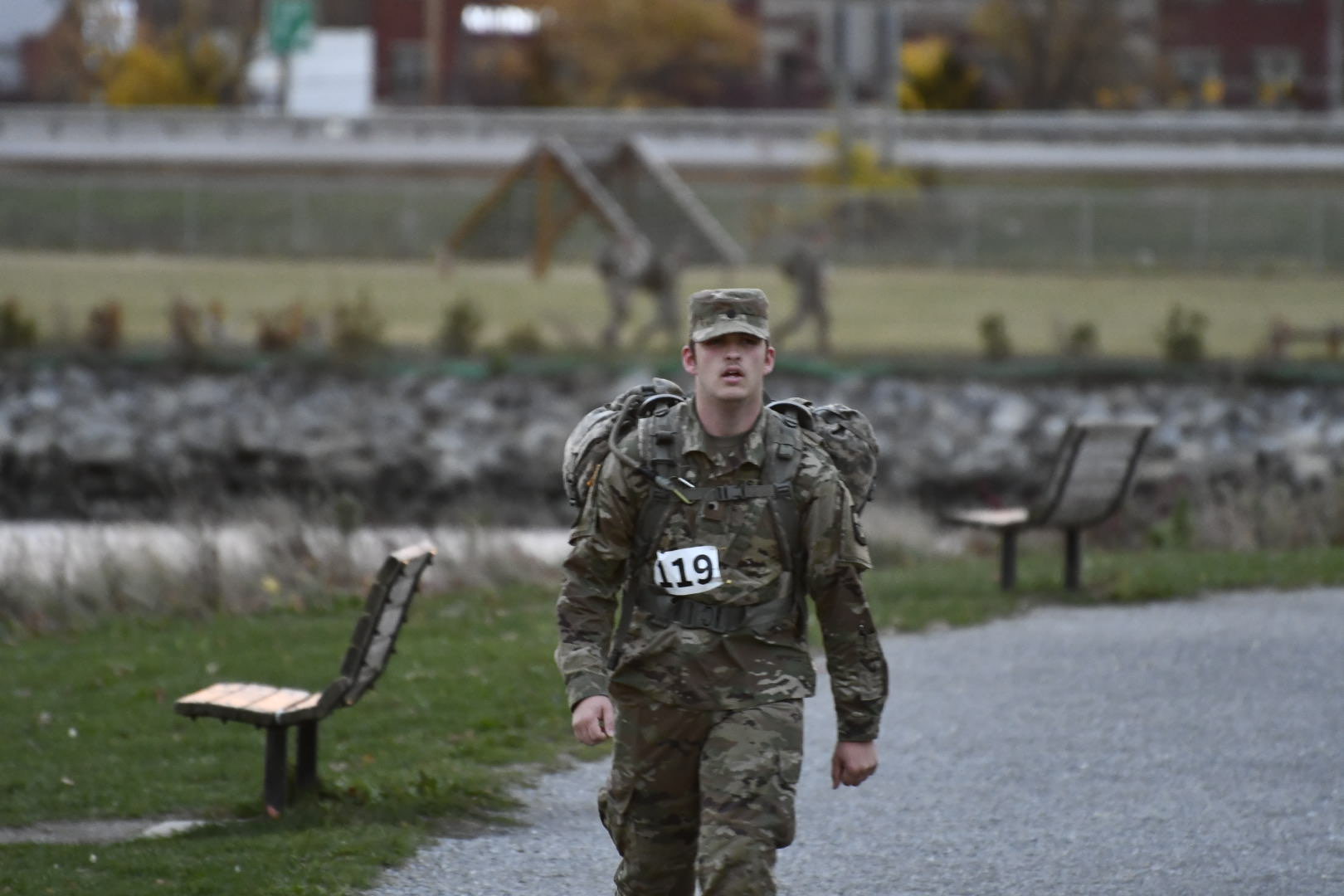
For students at Husson University interested in becoming a military officer, the Army Reserve Officers’ Training Corps program, or ROTC, is providing a path forward while they earn their college degree.
The program is offered jointly to students at Husson and the University of Maine in Orono, who train together.
For students like Justin Alexa, a freshman studying criminal justice, the ROTC program is a chance to continue the work he started as a high school freshman in Junior ROTC.
"What really sold the deal was that Husson and UMaine had the joint program, so I knew I could still continue doing what I liked in high school and still get that career path while going to a more community based school rather than a big state school that I would get lost in," Alexa said.
About a month into his first semester, an upperclassman asked if he wanted to do a Norwegian ruck march in Portland. A Norwegian ruck march is a 18.5 mile hike carried out with a 25 pound backpack. The training exercise is a test of endurance borrowed from Norwegian military tradition. Alexa said yes without hesitation.
“So we drove down to Portland, we did the whole ruck, and I was texting my friends as I was doing it like, ‘hey, you’ll never believe what I’m doing,’” Alexa said.
The ruck march was just the beginning of the many opportunities the ROTC program gives to Cadets that Alexa said you can’t find anywhere else on campus.
“Every year we get two or three slots to send cadets to higher training schools, like airborne and air assault. So you could be a sophomore, junior, or maybe even a freshman in college and you’ll get to learn how to jump out of planes and helicopters,” Alexa said. “So there’s definitely a lot of cool opportunities and a lot of unique adventures that I don't think you would really get anywhere else other than in this program.”
Those openings don’t come easy. Sergeant First Class Kevin Braasch, who helps run the ROTC battalion, said cadets who want to attend the higher training schools have to meet not only certain GPA requirements but also must pass fitness tests to be considered.
“Then depending how many seats we have for that course they will have to out perform their peers through an additional physical assessment tailored to the course,” Braasch said.
Michael Kamorski, an associate professor in Husson's School of Criminal Justice and the university's military faculty representative, agrees. Kamorski has been facilitating Husson’s ROTC program since he arrived on campus in 2014. He came to the role with experience on both sides of the program, as a cadet who was commissioned into the Air Force in the 1990s and as director of operations of an ROTC unit at the University of Virginia.
“ROTC is there primarily to make sure this person is fit to be an officer. In the military, there's enlisted, and they are the backbone of the military by far, it's 75% of the military,” Kamorski said. “But they need to be led by people who know what they are doing as well.”
Husson has maintained an agreement with UMaine's Army ROTC program for over a decade. Students who want to pursue commissioning as a military officer enroll through Husson but train alongside UMaine cadets at facilities in Orono four days a week.
Arrangements like this one are standard practice across the country, Kamorski said. Detachments routinely absorb students from nearby schools rather than each campus running its own program. The cost of running one program alone makes those arrangements necessary and allows for students at smaller schools the opportunity to participate in ROTC.
The weekly schedule for Cadets includes physical training Monday, Wednesday and Friday, with labs on Thursdays covering basic military and leadership skills. A few times a year, the battalion holds field training exercises over the weekends, sometimes in Orono, sometimes at out-of-state training facilities.
"And then occasionally they'll have what's called FTX's or field training exercises, and typically that requires a release on Friday, because they go through the weekend. So that may be a resident up there in the woods of UMaine, camping out and doing a field type exercise. Or occasionally they'll actually go off site and have an FTX at a military installation, either through a guard unit, or I know they've traveled as far as Fort Devens in Massachusetts," Kamorski said.
Kamorski points to the Thursday lab as the real core of the program. That's where the basic, yet important skills get built, not through lectures, but being around people who have already done the job.
"You’re being exposed for four years to military professionals who have done what you want to do,” Kamorski said. “That exposure to the professionals who have been there, done that, it's just something that you really can't get in a classroom."
Braasch said that learning those skills as a cadet in ROTC carries over to the work they will be doing as officers in the military, leading others to do those same tasks.
“They may not be the individual performing that skill level one task, but they will lead young men and women and it’s grounding as a leader to know what they’re having them do. If you’ve never changed your own oil before you may go to the mechanic and have no concept of time for the task you’re asking to have done,” Braasch said.
For those considering the program, both Kamorski and Alexa give the same basic advice: think hard about whether you actually want to serve before worrying about anything else. The smaller details, job specialty, branch, commitment length, come later. The foundational skills and professionalism have to come first.
— Calvin White