

Husson’s Student-Led Boxing Clinic is Giving People with Parkinson's a Workout and Community
Published on: March 16, 2026
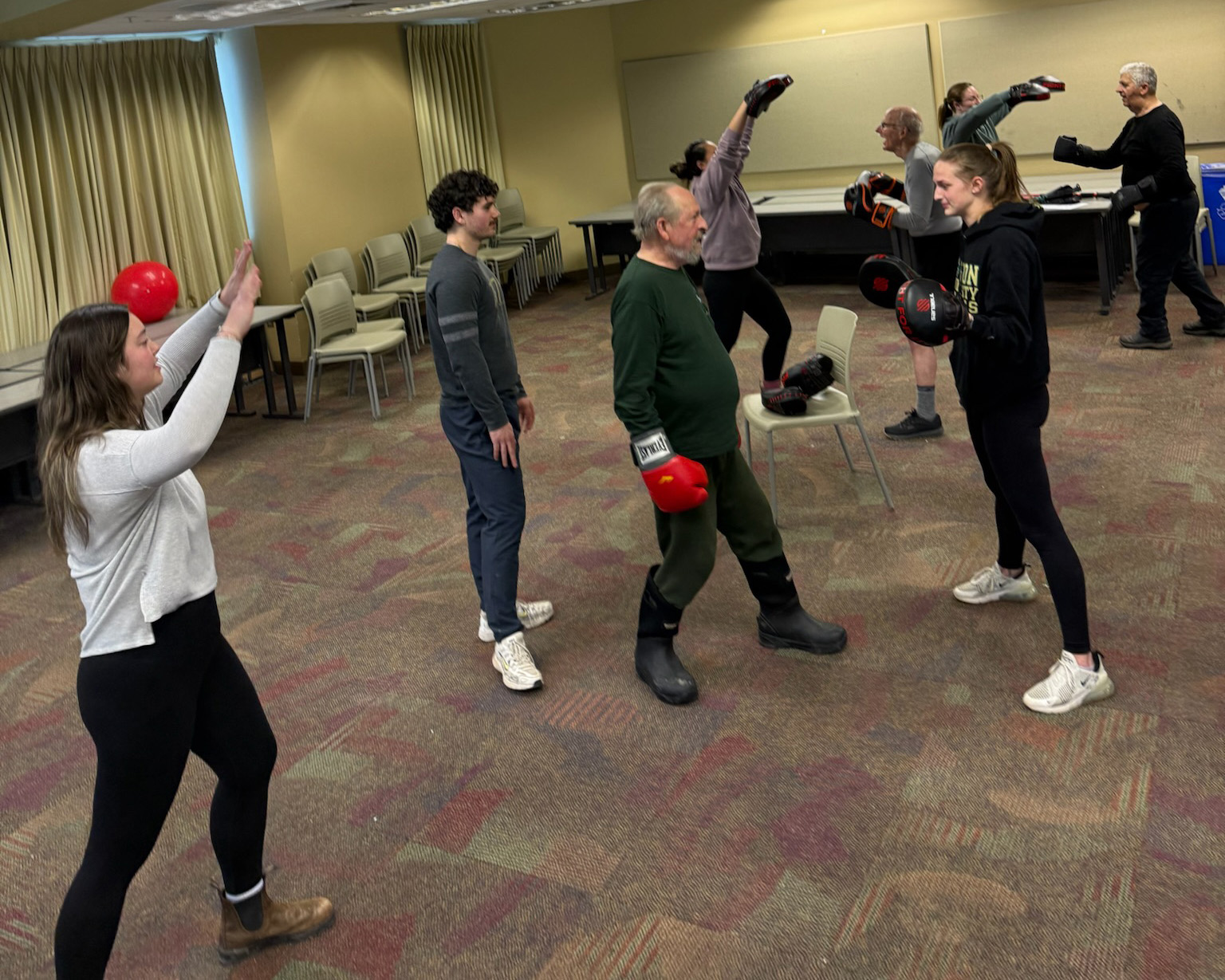
On Wednesday afternoons, Husson University’s Libra Lecture Hall transforms from a classroom into a boxing clinic. Tables and chairs are pushed aside and students in Husson’s Doctor of Physical Therapy program trade in their notebook for boxing mitts as they help lead people living with Parkinson’s disease through an hour-long session of high intensity movement and drills.
The Husson Fighting Eagles Boxing Clinic welcomes is a free and student-led program, designed to provide consistent exercise in a supportive and social setting for people living with Parkinson’s disease in the Bangor area.
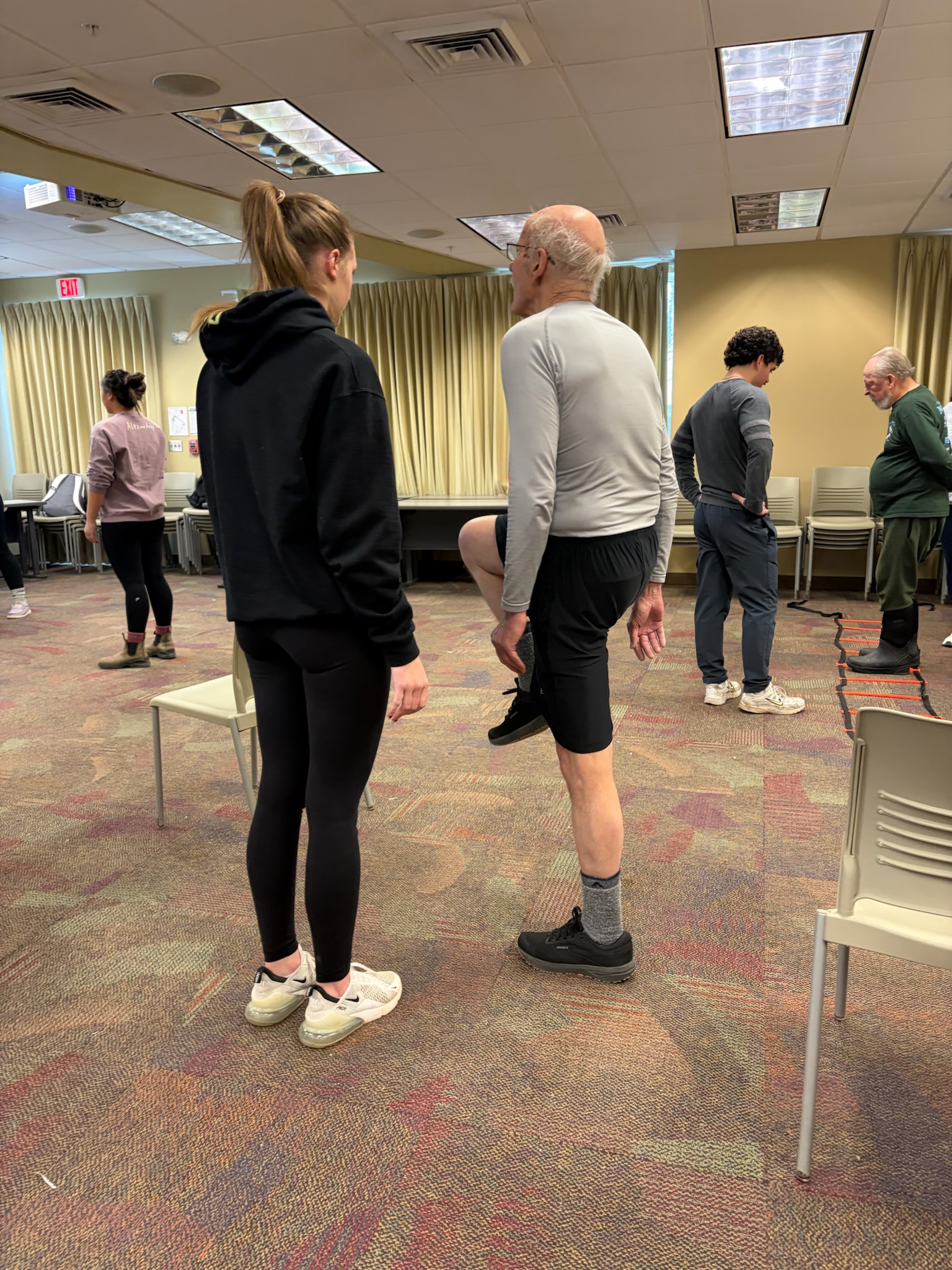
“The students really facilitate the exercises, interface with participants, recruit people, and I supervise for safety,” said Dr. Heidi Moyer, the faculty supervisor and a board certified neurologic physical therapist. “And if there’s any participants with higher needs, I help the students fill in the gaps.”
Each session starts with a warm-up focused on large, deliberate movements, about 30 minutes of circuit-style stations, and a closing 30 minute boxing segment where participants punch mitts held by student volunteers and practice their footwork.
“Parkinson’s is caused by a loss of neurons within a part of the brain called the basal ganglia. And that part of the brain controls big movements. So when we lose those neurons in the brain, it makes the movements very small,” Moyer said. “We have found that through big, high intensity movements, called high amplitude movements, we’re able to force a stronger signal through part of the brain. And through consistent exercise it decreases the symptoms of the condition."
Jinny Clifton, a second-year graduate student in the Doctor of Physical Therapy program and co-president of the club, said her experience with the clinic has advanced her education.
“I’m very much a hands-on learner and a lot of our classes are lecture material and we are learning interventions for Parkinson’s disease right now,” Clifton said. “So just being able to apply those skills to real life situations and real life people is preparing me for going out into the field.”
For co-president Leah Duval, now in her fifth year at Husson, her involvement the club started as an intimidating first visit.
“I was the only sophomore there. It was all graduate students. I was terrified at first,” Duval said. “But I just fell in love with it because it’s supposed to be fun, supposed to be social, and it’s not really physical therapy treatment, but it is just disguised as something fun now.”
Duval said that the social aspect of the clinic matters as much as the physical work.
“It’s a big social and mental thing too, because something with Parkinson’s is they can get very kind of closed off to the rest of the world. So having just an hour of social time with other people means a lot.”
Student volunteer and exercise science junior Zoey Halmen said the clinic’s environment creates something deeper than a workout.
“It gives them a sense of community in the sense of ‘I’m not alone in this’, it shows them that these are my people that may be struggling with the same thing and we’re all here together.”
For participants like Bill Phillips, who has attended the clinic for three years, outside of the exercise the community is what keeps him coming back.
“I like interacting with the students, and to a certain extent I like the idea of helping to train the students to expose them to people like us, and get them ready for the real world,” Phillips said.
Curt Rozelle, who has been coming to Fighting Eagles sessions for about two years, keeps his reasoning simple.
“It’s free, it helps educate the students, and it helps you with your problems,” Rozelle said. “I really believe with Parkinson’s you gotta keep moving, and that’s the biggest thing with it. And they keep us moving here.”
While participants work through stations and punches, caregivers often sit nearby, talking. Moyer described it as an informal support system. “The club kind of becomes almost a little bit of a support club,” she said. “It’s also a really good chance for intergenerational contact too.”
For students, the clinic offers something a classroom cannot. “It’s one thing to be hands on, but it’s another thing to be hands on with the person with the condition,” Moyer said. “There is only so much that we can simulate in a classroom setting.”
By the end of each session, gloves come off and the room settles. Some participants linger to talk. Students gather equipment and compare notes. The clinic may last only an hour, but its impact goes well beyond it, into future careers and into the daily lives of those who walk through the doors each week.
— Calvin White